

Kernel Media Project
Supporting the development of collaborative media projects
February 25 to March 18, 2026
Creation of a collaborative newspaper
Lausanne - Bibliothèque Chauderon
Ville de Lausanne – Bibliothèque Chauderon – MagTuner
2026 – Creation of a collaborative newspaper at the Chauderon Library

This newspaper is the result of writing workshops led by Thomas Zoller with young people who were — or were not — registered with the libraries. The workshops were created to offer a space for expression, creativity and exchange around young people’s ideas and perspectives on the world around them.
The participants did not necessarily know one another: they came from different neighbourhoods of the city, and in some cases from nearby municipalities. The project therefore gave them the opportunity to meet, to work as part of a guided group, while still enjoying a great deal of autonomy, in order to create a collective newspaper.
Through writing, photography and layout, the young people discovered the process of creating a publication. They experimented with cooperation, developed their analytical skills and learned to make their points of view heard. More than the final result, it was the process itself that was at the centre of our attention.
This project is part of the mission of public libraries to foster cultural participation and support the development of critical thinking. It also reflects the in-depth work carried out by the Libraries of the City of Lausanne around the themes of the UN 2030 Agenda, explored through our mediation activities in 2025 and 2026.
The published content faithfully reflects the contributions, questions and imaginations of the participants.
Impressum
The editorial team
Alice, artistic director – Arthur, Journalist – Clémence, Journalist – Hayet, editor-in-chief – Héloïse, editor-in-chief – Irene, Journalist – Juliette, editor-in-chief – Lía, Journalist – Maya , Journalist – Mondo, Journalist – Noan , Journalist – Nolan, Journalist – Raphaël, Journalist – Ruben, deputy editor-in-chief – Tyméa, Journalist – Yuna, Journalist.
The library team
Coralie – Fanny – Jean-Jacques – Julie – Marylène.
The MagTuner team
Alex – Anna – Pierre – Thomas.
Cover design: Lily Caldwell
Cover photography: Mathilde Imesch – City of Lausanne


The jury, from left to right: Sarah Clément, cultural journalist, columnist for the programme “Vertigo” — special New Romance edition — and literary interviewer for the podcast “Qwertz”; Julie Bosquet, librarian; Raphaël Jotterand, journalist at Le Temps and winner of the Best Young Journalist Award 2023–2024; Michel Eymann, retired former RSR journalist; and Marylène Chevalley, cultural mediation officer for the City of Lausanne.
The librarians Coralie Chatelan, Fanny Barras and Jean-Jacques Charrière took part in the vote remotely.
Le Mille – a challenge of considerable scope
Immersion in the making of news
Creating a newspaper with sixteen young people in just four two-hour sessions was already a major challenge. But the project’s true ambition did not lie solely in producing a twelve-page newspaper. It lay in a far more daring undertaking: giving the participants an understanding of all the mechanisms that allow a media outlet to exist.
Writing content is already a challenge in itself. Finding topics, conducting interviews, structuring an article, checking information, meeting deadlines: these are all demands that would be enough to fill an entire project. And yet, it seemed impossible to limit the experience to this practical dimension alone.
The decision was therefore made to go further.
Imagining a newspaper
From the very first sessions, the participants were placed in the role of true media founders. Together, they reflected on the kind of newspaper they wanted to create.
They chose to develop a weekly newspaper rooted in local news, while remaining open to national and international issues. They defined a readership made up of 70% young people and 30% adults, as well as a general-interest editorial line. As for the tone, it had to be serious without being austere, rigorous while remaining accessible and relaxed. The different sections were then imagined, discussed and collectively approved.
Giving the newspaper an identity
During the second session, a young graphic designer in training joined the project in order to receive a real commission for the newspaper’s cover. The participants had to explain their vision, their positioning and their graphic expectations to her.
This exercise helped them understand that every visual choice responds to specific editorial objectives, and that a cover is much more than simple graphic packaging: it is the first encounter between the newspaper and its readers.
The young people also decided that the cover photograph would be taken by the photographer of the City of Lausanne. They gave her a photographic brief so that the chosen image would reflect the identity and values of the newspaper they had collectively imagined.
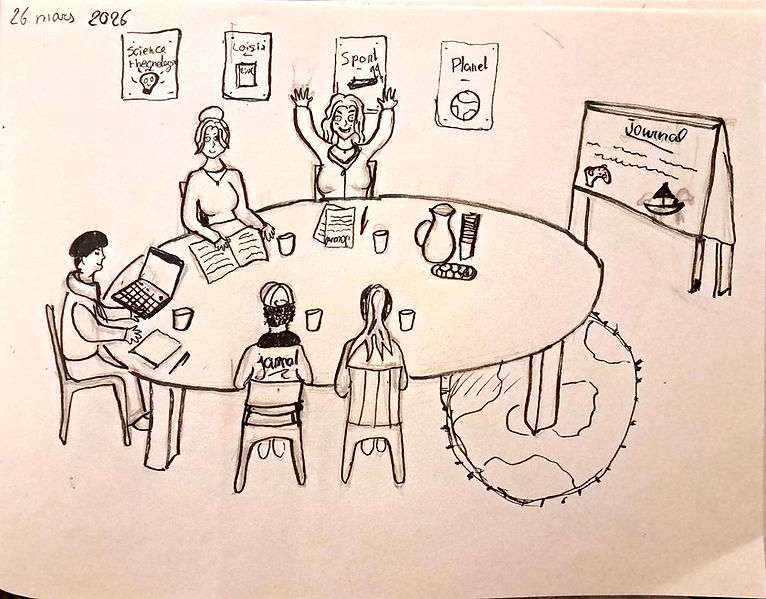
Finally, during the last session, they wanted to illustrate the final page with an original drawing capturing the atmosphere of the workshops. The commission was entrusted to Tyméa’s sister, who drew a scene representing the team’s collective work. A beautiful way to preserve a trace of this human adventure.
The culmination of a beautiful adventure
To mark this achievement, a jury made up of three professional journalists and the library mentors awarded a prize for the best article and a prize for the best photograph. Members of the mentoring team who were absent during the votes were also able to take part in the decisions remotely. Their votes were collected by email, allowing everyone to contribute to the collective choices despite scheduling constraints.
A few days later, the newspaper went to print. Printed in 750 copies, it was inaugurated at the Chaudron Library in front of the young journalists, their families, the project partners and the library teams.
The ceremony made it possible to celebrate not only the final result, but also the entire journey.
A unique experience.
Beyond the 12 printed pages, this project offered the participants a rare experience: the chance to discover the entire process of creating a newspaper.
They did not simply learn how to write articles. They learned how to think about a readership, build an editorial line, organise a newsroom, work with a graphic designer and a photographer, commission content, debate, vote, take on responsibilities and make collective decisions.
Ambitious? Certainly.
A little crazy? Probably.
But above all, profoundly formative.
For four weeks, these sixteen young people did not simply play at being journalists. They lived a genuine newsroom experience and discovered, from the inside, how information comes into being. A human, collective and pedagogical adventure that will remain in the memories of those who took part for a long time to come.
A newsroom like the big ones
Once the foundations of the newspaper had been laid, the next step was to build the editorial team. Following a vote, Héloïse and Juliette were elected editors-in-chief. They then formed their steering team, with Ruben as deputy editor-in-chief, Hayet as managing editor and Alice as artistic director.
Each section also appointed a person in charge, responsible for representing their team during editorial discussions.
This organisation allowed the young people to gain a concrete understanding of how a newsroom works, but also of the notions of responsibility, collaboration and collective decision-making that are part of producing information.
Remarkable commitment
Over the weeks, the articles took shape, interviews were conducted, photographs were selected and the pages were gradually filled.
As the deadline approached, the commitment of both the young people and the library mentors continued to grow. During the final weekend before the production deadline, several participants even continued working from home in order to finalise their texts and meet the deadlines they had set for themselves.
The young people then voted on the final cover design — during a video conference with Lily Caldwell, who presented the two commissioned design options — approved the final editorial choices and submitted their articles.
The library team then intervened only to make the spelling and grammar corrections required for printing, while ensuring that the authors’ content, style and editorial choices were fully preserved.
The challenge, perhaps a slightly crazy one, was to give the participants not only the practical tools of journalism, but also the theoretical foundations that allow a media outlet to exist. It was not simply about producing content, but about discovering everything that comes before writing: defining a newspaper’s identity, its readership, its editorial line, its tone, its organisation and its responsibilities.
This pedagogical dimension formed the heart of the project. It required a significant investment, but it was essential in order to offer the young people a complete experience. Because it is by combining theory with practice that one can truly understand how a media outlet works and the role it plays in society.
Best Article Award

Juliette awarded for the most original article
With her contribution The Weather of the World, Juliette won the prize for the most original and playful article.
Her idea? To present international news in the form of a weather forecast, linking each continent to an unusual or surprising piece of information.
Thanks to a creative layout and a light tone, she managed to take readers on a journey to the four corners of the planet while keeping them informed. It was an original way to discover the news, and one that won over both the jury and the readers.
Congratulations to Juliette for her imagination and her sense of journalistic innovation!
The Big Photo Contest


Knowing that the young people did not have enough time to create illustrations for their articles, we chose to dedicate a double page to photography.
With his magnificent shot of Sunset at Cable Beach in Australia, Arthur won the prize for the best photograph of this first edition. His image immediately won over the voters with its vivid colours, peaceful atmosphere and the beauty of the landscape he captured.
This photograph invites both travel and contemplation. It also reflects Arthur’s attentive eye, capable of capturing a unique moment and sharing it with the readers.
Congratulations to Arthur on this wonderful award and on this visual journey to the beaches of Australia.
Le Mille (The Thousand)
Chosen unanimously, this name refers to the postal codes of the city of Lausanne, which all begin with “1000”. The young people, who come from different neighbourhoods of the city, chose it to highlight both the newspaper’s local roots and the diversity of those who bring it to life.
Through this title, they wanted to show that, despite their different backgrounds and perspectives, they share the same adventure.
Le Mille therefore symbolises what brings them together, connects them and unites them around a common project.


Page


Download the PDF
