

Kernel Media Project
Supporting the development of collaborative media projects

Understanding media by making them
Our approach
A pedagogical method based on the real production of media.
A method rooted in practice
Our method was born from practice, in our youth newsrooms. A newspaper is never made alone: it brings together different skills, which reach their full value together. Our framework is designed to serve this shared project.
The newspaper sets the rules
As early as the 1920s, Célestin Freinet gave children the means to typeset, print and distribute their own newspaper. We carry this idea forward with today's tools. The framework is the newspaper itself: a number of pages, a deadline, a printer, readers. These constraints are demanding and shared by everyone: they direct each person's work towards a common goal.
A circular organisation
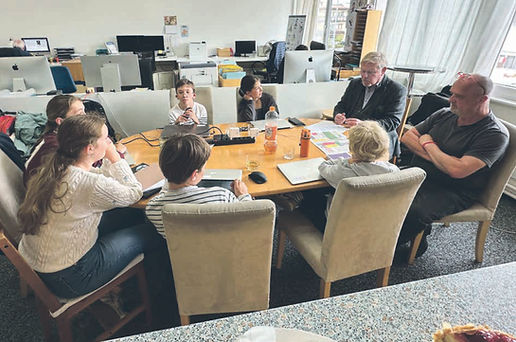
Our organisation draws on Scrum, an agile method that emerged in software development: a self-organising team, and roles understood as responsibilities rather than ranks. Each role is taken on by proposal: participants put themselves forward for the mission they want to take on; if several volunteer, the newsroom votes. The functions of a professional newsroom do exist, but they do not rank people. The organisation is circular rather than vertical, like the round table of our shared meal, where no chair is higher than another.
Everyone finds their place
The roles cover a wide range of skills: writing, photographing, drawing, layout, proofreading, coordinating. Everyone proposes their contribution, adjusts their ambitions and negotiates their place with the group: defining themselves, but never once and for all. A chosen place is not a refuge, though: the adult makes sure everyone also takes on what challenges them. Some roles are shared by two people, never more, to encourage and stabilise commitment.
A review after every issue
As in Scrum, each issue is a complete cycle that ends with a retrospective. The newsroom looks at the goal, the process and the result. Each member asks what they would do differently, then the group gives its view, in light of the mandate each person had accepted. Mistakes are not failures: they become leads for the next issue.
Commitment is a contract between peers
Everyone commits to the group on a specific mandate. When a commitment runs into difficulty, it is first the members of the newsroom who talk it over among themselves. Recognition comes from the newspaper being published and read, and from the group's review of each person's mandate. It circulates among the young people themselves, who speak of “our newspaper”.
The adult designs the situations
The adult accompanies: they observe, offer their perspective and create the conditions for progress: an adapted format, a tailor-made section, a challenge within everyone's reach. The group organises itself; the newspaper sets the rules.
Our references
Built in the field, our method has turned out, in hindsight, to align with two traditions: cooperative and project-based pedagogy, from Célestin Freinet to Sylvain Connac and Philippe Perrenoud, and agile methods such as Scrum. It puts the collective work at the centre: a newspaper that is published, read, and then reviewed together after every issue.
An approach that can be transferred to schools?
Since 2014, we have also run projects with schools: workshops at HEP Vaud, Media Week at School, newspapers produced with classes in just a few days, and more than 450 pupils during the 2020 Youth Olympic Games. These experiences lead us to believe that this approach can also find its place in the classroom. We would like to develop it with schools, building it each time together with teachers.
Learning by
doing

Learning begins with
action.
Participants observe, look for topics, ask questions, write, correct and improve their work throughout the project.
Practice becomes a concrete framework for developing attention, curiosity, rigour and the desire to understand.
Working as a newsroom

Each project is organised like a newsroom.
Participants take on roles, discuss topics, debate angles, reread content and learn to take the reader into account.
They discover that a media outlet is not simply a series of articles, but a collective organisation made of decisions, responsibilities and cooperation.
Structuring with MagTuner

MagTuner supports the making of the newspaper.
The platform makes it possible to visualise pages, structure content, follow the progress of the work, correct and prepare publication.
The tool does not replace human guidance. It simply makes the process clearer, more accessible and more collective.
Publishing in a real context

Publication gives meaning to the work.
The content produced does not remain within a closed exercise: it is intended to be read, shared, printed or published with partners.
This stage changes the participants’ commitment. It helps them understand the responsibility linked to information, images, word choices and public speech.
A simple process
Each project follows a clear progression. This structure allows a group to gradually become a newsroom capable of producing a completed editorial object.
-
Set up the framework
-
Define the nature of the publication
-
Identify the target reader
-
Form a newsroom
-
Choose roles
-
Define the topics
-
Produce the content
-
Correct
-
Lay out the publication
-
Publish
-
Hold a retrospective
-
Document
Contact
Kernel Media Project
Non-profit organization
Avenue William Fraisse 10
1006 Lausanne, Switzerland
+41 (0)76 341 02 35